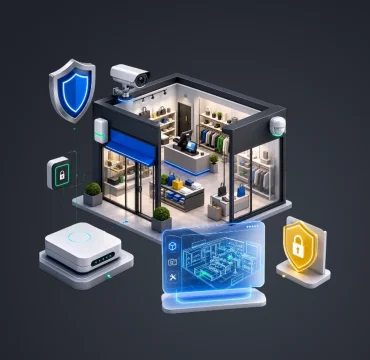
Alarm Systems and Video Surveillance for Restaurants and Cafés in Berlin
Restaurants, cafés, bars, bistros and snack bars have special security requirements. During opening hours, guests, employees, cash, food, equipment and personal belongings are present on the premises. After closing, checkout areas, storage rooms, kitchens, refrigeration equipment, stock, alcohol, machinery and furnishings are often left unattended. A suitable alarm system and professionally planned video surveillance help detect break-ins, theft, vandalism, fire and water damage at an early stage.
Olex Schluesseldienst supports hospitality businesses in Berlin and the surrounding area with the consultation, planning and installation of modern alarm systems and video surveillance. We help you secure your restaurant or café appropriately – taking into account the size of the premises, opening hours, staff structure, location and daily operations.
A good security solution for the hospitality sector should not get in the way. It must work reliably, be easy to use and take day-to-day operations into account. Guests should feel comfortable, employees should be able to work without unnecessary complications, and operators should know that their premises are protected even outside opening hours.
Why Restaurants and Cafés Need Special Protection
Hospitality businesses require special protection for several reasons. They often contain cash, payment equipment, tablets, coffee machines, kitchen equipment, spirits, stock and expensive furnishings. At the same time, restaurants and cafés are open to the public. Many people enter the premises every day, so it is not always immediately apparent who is a guest, supplier, employee or unauthorised person.
After closing, the risk profile changes. Entrances, windows, storage areas, the kitchen, bar area and terrace then become the main focus. Poorly visible rear entrances, basement doors, delivery entrances, courtyards, side entrances and display windows are particularly vulnerable.
Typical risks in restaurants and cafés include:
An alarm system cannot eliminate these risks completely, but it can detect incidents early, report them and have a deterrent effect.
Alarm Systems as Part of a Complete Security Concept
An alarm system should always be combined with mechanical burglary protection. Strong doors, secure locks, lock cylinders, security fittings, window security devices and tested retrofit solutions make forced entry more difficult. The alarm system complements these measures by detecting attempted openings, movement or glass breakage and reporting them immediately.
For restaurants and cafés, this combination is particularly important because many premises have several access points:
During planning, we check which areas should be better protected mechanically and where electronic detectors make sense. This creates a clear security concept for the business rather than a random mix of technology.
Which Areas Should Be Monitored in Hospitality Businesses?
Not every area of a restaurant or café needs the same level of monitoring. What matters is where there is an actual risk and which areas are particularly sensitive in everyday operation.
Entrances and Access Points
Checkout and Counter Area
Kitchen and Technical Areas
Storage and Cold Rooms
Staff Rooms and Office
Smart Alarm System with App Control
Modern alarm systems can be conveniently controlled via an app. This is particularly practical for hospitality businesses because opening hours, staff changes, delivery times and closing routines are often flexible.
Typical functions of a smart alarm system for restaurants and cafés include:
A clear user structure is particularly helpful. Not every employee needs the same permissions. Owners, shift managers, cleaning staff or external service providers can be given different access rights. This makes it possible to track when the system was operated.
Planning Video Surveillance in Restaurants and Cafés Correctly
Video surveillance can be useful in hospitality businesses, but it must be planned very carefully. Restaurants and cafés are places where guests eat, drink, talk and spend extended periods of time. For this reason, surveillance of seating areas, dining rooms, tables or lounge areas is particularly sensitive from a legal perspective and in many cases is not permitted or is only possible to a very limited extent.
It is generally more appropriate to plan video surveillance specifically where there is a concrete security interest and the intrusion is kept as limited as possible. Depending on the premises, this may include:
Important: Cameras should not be installed indiscriminately. They must not simply record public pavements, streets, neighbouring properties or other people’s private areas. Employees’ rights and information obligations must also be taken into account. Video surveillance should therefore always be planned with a clearly defined purpose, sensible camera positioning and the narrowest practical field of view.
A good solution provides useful images when an incident occurs without unnecessarily monitoring guests or employees.
Protection Against Fire, Smoke and Water Damage
Fire and water damage can be particularly serious in restaurants and cafés. Kitchens, coffee machines, dishwashers, deep fryers, electrical appliances, refrigeration equipment and water pipes are part of daily operations. If damage occurs after closing, it is often not noticed until much later.
Depending on the premises, the following detectors may be useful:
A water detector under the dishwasher, near the coffee machine or in the basement can provide an early warning. Heat detectors can be useful where smoke detectors would be unsuitable because of normal kitchen operations. Professional planning is important so that the equipment does not constantly trigger false alarms.
Such a solution does not replace any mandatory fire-safety measures, but it can be very valuable as an additional means of hazard detection in everyday operation.
Security Outside Opening Hours
Most security-related incidents do not occur during normal business hours, but before opening, after closing or at night. The system should therefore be planned to match the actual operating routines.
Typical situations:
Zone control is useful in such cases. For example, the storage area, kitchen and rear entrance can already be protected while staff are still tidying up in the dining area. Or the perimeter protection can remain active while authorised persons enter through a designated access point.
Avoiding False Alarms
Hospitality businesses have many factors that can cause false alarms: heat sources, steam, air movement, changing light conditions, animals, open windows, cleaning work, delivery times and different employees. Professional planning is therefore particularly important.
During installation, we pay attention to:
An alarm system should support the business, not get in the way. The easier it is to operate, the more reliably it will be used in everyday life.
Which Hospitality Businesses Is the Solution Suitable For?
Alarm systems and video surveillance are suitable for many types of hospitality businesses, for example:
Even small cafés can be well protected with a few carefully selected components. For larger restaurants, a more extensive concept with multiple zones, app control, cameras, sirens and hazard detectors may be appropriate.
Consultation and Installation in Berlin and the Surrounding Area
Olex Schluesseldienst provides consultation, planning and installation of alarm systems and video surveillance for restaurants and cafés in Berlin and the surrounding area. We help hospitality businesses find a security solution that fits the premises, operations and budget.
We operate in Berlin-Mitte, Charlottenburg-Wilmersdorf, Friedrichshain-Kreuzberg, Pankow, Reinickendorf, Spandau, Tegel and also in Falkensee, Glienicke / Nordbahn, Hennigsdorf, Hohen Neuendorf, Oranienburg and Velten, among other locations.
During the consultation, we assess entrances, windows, checkout area, kitchen, storage areas, staff areas, outdoor spaces, delivery entrances and existing locking technology. This forms the basis for a security concept that sensibly combines burglary protection, alarm notification, video surveillance and hazard detection.
Process: From Consultation to a Fully Operational System
The main entrance, rear entrance, supplier entrance, basement, display windows, checkout area, storage areas, kitchen and staff rooms are particularly important. Depending on the premises, the terrace, courtyard or outdoor area may also be relevant.
Video surveillance in the dining area is legally very sensitive because guests spend extended periods of time there. In many cases it is problematic. Targeted monitoring of entrances, storage access points or security-sensitive areas with a clearly limited field of view is usually more appropriate.
Yes. Many modern systems allow different user permissions. Owners, shift managers, cleaning staff or service providers can have their own access, making system operation traceable.
In addition to intrusion detectors, smoke, heat, CO and water detectors may be useful. The kitchen, dishwashing area, basement, technical room and areas with coffee machines or refrigeration equipment should be assessed in particular.
Depending on the system, schedules, reminders or zone switching may be possible. Nevertheless, the solution should match the actual operating routines so that cleaning, deliveries or late closing do not cause false alarms.
Related Services