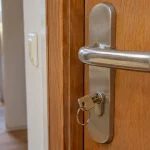


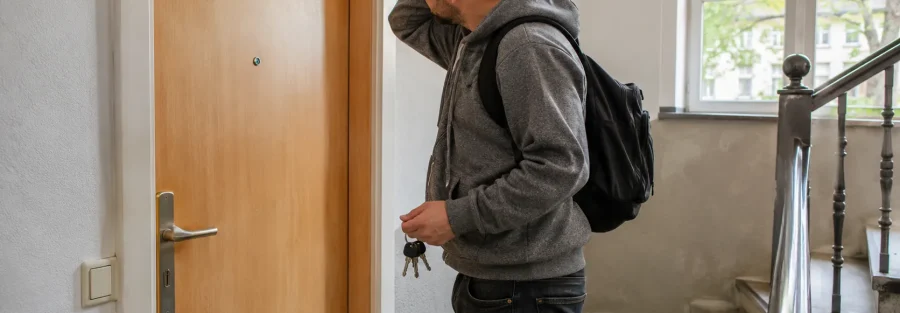
When a conventional door merely clicks shut, the spring latch holds it closed. Locking it with a key engages the bolt as well. This distinction matters for professional opening methods, potential damage, likely costs and home security.
Pulled shut or locked: What is the technical difference?
On a typical mortice lock, a door that has merely clicked shut is held by the spring latch. When it is locked with a key, a deadbolt is additionally engaged. The latch and bolt have distinct functions, even though both interact with the door frame. Exact behaviour depends on the door and locking system.
“The door is shut” describes what you can see, not its mechanical state. The important question is whether the key was turned after closing. A door that has simply latched should not be mistaken for one that has been properly locked. The ABUS technical glossary explains terminology for the components of a lock.
| Feature | Merely latched | Locked with a key |
|---|---|---|
| Mechanism | The spring latch holds the door shut; on a conventional lock the deadbolt remains retracted. | The deadbolt has been engaged, potentially alongside other locking points. |
| Professional opening | A low-damage solution may be feasible, depending on the door. | Different specialist measures may be necessary; the work can be more demanding. |
| Security | Closing alone does not replace locking. | The intended locking mechanism is engaged, assuming it works correctly. |
| Replacement | Not automatically required. | Not automatically required; an inspection determines what is necessary. |
Why it matters to a locksmith
Before starting, a locksmith should establish the type of door, the lock, whether the locking mechanism is engaged and whether anything is damaged. A door held only by its latch may offer better conditions for a careful opening. Yet there is no universal guarantee of damage-free work. Door seals, warped components, added security fittings and mechanical faults may affect the options.
If the door has been locked, the active bolt or multiple locking points have to be taken into account. Security escutcheons and the cylinder design can also influence the job. That does not mean drilling or full lock replacement is always necessary: any decision should follow an assessment on site.
How to identify the situation
Think about what happened just before you were locked out. Did the door blow shut or click shut behind you without anyone turning the key? On a conventional lock, it was probably only latched. If you turned the key to secure the door and removed it, it was probably locked.
There are exceptions. Self-locking multipoint systems and certain electronic locks can engage additional locking points automatically as the door closes. The position of the handle alone is not a reliable indicator. When calling for help, say “probably latched” if you are unsure.
- Recall whether you turned the key after shutting the door.
- Find out whether someone authorised has a spare key.
- Mention any extra lock, multipoint system or automatic locking feature.
- Say whether a key is left inside, has broken, or the mechanism was already sticking.
What should you do outside the door?
First decide whether anyone is in immediate danger. A fire, a person facing an urgent threat or a comparable emergency calls for the emergency number 112 in Germany. Ordinary lockouts without a safety emergency are not a reason to call the emergency services.
Otherwise, contact someone you trust who is authorised to use a spare key. If that is not possible, find a local locksmith. Describe the address, door and suspected locking state. A reputable locksmith may ask you to show evidence that you have permission to enter.
Costs, possible damage and agreeing the work
Whether a door has been locked can affect the work involved. However, that is only one factor. The type of door, security fittings, existing faults, time of day and travel distance matter as well. Ask for a clear explanation rather than assuming every locked door requires replacement.
The German Verbraucherzentrale consumer advice service recommends choosing a genuinely local provider, agreeing a fixed total price where possible, including travel and supplements, and requesting an itemised invoice. Describe the problem precisely and commission only the work you need. Replacing the entire lock is usually not automatically necessary.
If the locksmith proposes more extensive work on arrival, ask why and agree any changed price before it begins. Read the invoice carefully and avoid signing terms you do not understand.
Why a door that has merely clicked shut is less secure
A latch holding the door closed does not necessarily mean the intended security bolts are engaged. Such a door may resist forced entry less effectively than the same door when correctly locked. Actual protection depends on the complete assembly: door leaf, frame, lock and fittings.
Germany’s police crime prevention service advises locking the entrance door whenever you leave, even briefly. Correct use of the lock matters alongside suitable mechanical protection. In an older Berlin apartment building, it may be worth assessing whether the door, hinges, frame and strike plates work together as intended.
Preventing lockouts without compromising security
Leaving a spare key with a trusted person can help prevent future lockouts. Do not hide keys under mats, flowerpots or other obvious places. Establish a simple routine: take your keys, shut the door and lock it properly when leaving.
A key that sticks, a handle that does not spring back or a door rubbing against its frame may indicate a fault. Professional lock repair (Seite auf Deutsch) or adjustment can be appropriate; worn or unsuitable parts may instead require a lock replacement (Seite auf Deutsch). The right approach depends on the particular door.
Fire safety is another consideration. Do not install or alter locking mechanisms in a way that compromises any applicable escape-route requirements. Seek competent advice where the situation is unclear.
Conclusion: Establish the locking state first
A latched door and a door locked with a key are not the same technical problem. Explaining which situation applies helps the locksmith assess the work and can prevent unnecessary interventions. For everyday security, remember that shutting the door is not a substitute for properly locking it.
Need a door opened in Berlin?
Unsure whether your door has simply latched or is fully locked? OLEX Schlüsseldienst can assess the situation and advise on the appropriate professional opening.